
How Does Automated Storage Improve Warehouse Efficiency in the Semiconductor Industry?
August 14, 2026
The semiconductor industry is experiencing rapid growth in India. By creating job opportunities and fostering local tech startups and global partnerships with AI, the industry is projected to reach up to $300 billion by 2035.
Summary
This blog reads about why the semiconductor industry requires an efficient warehouse for storage and retrieval and how automation plays a role in the process.
Why does the semiconductor industry require safe storage?
Components such as ultra-pure silicon wafers, dies, microchips and integrated memory system components are highly sensitive and valuable. Keeping them unsafe can lead to huge losses. Some of the key reasons why they need to be stored safely are:
Appropriate Storage Conditions: It is important to store semiconductor components such as fragile microchips and silicon wafers in optimal conditions. Simply storing them in inefficient storage conditions that might build up dust, emit sudden shocks, or have moist conditions leading to corrosion or oxidation of metal might ruin the components and the entire batch production process. Also, challenges related to electrostatic discharge (ESD) and chemical degradation can ruin entire production batches.
Shelf Life of Products: To better manage the shelf life of products, inventory methods such as FIFO (First In, First Out) and LIFO (Last In, First Out) result in better shelf life and minimise obsolescence.
Quick retrieval and storage: Sometimes a warehouse might require rapid and small orders. Organising stored items efficiently allows quicker retrieval and storage of items.
SKU Optimisation: The semiconductor industry has components with multiple variants that are difficult to keep track of. This situation requires a warehouse to have an efficient storage and inventory management system to keep better track of stored items.
What are the benefits of an Automated Storage System in the semiconductor industry?
- Improved space utilisation and optimisation to store products with a minimal footprint.
- Automated processes lead to fewer human interventions, which result in minimising delays in operations, human errors, accidents, and breakage of fragile or heavy components.
- Using RFID and batch technology to easily identify items. This is used for short, rapid deliveries.
- Software-integrated systems (WMS) for real-time tracking and inventory accuracy for SKU optimisation.
Conclusion
To sum up, outdated storage solutions decrease warehouse efficiency, leading to production delays or even completely disrupting the production process due to unsafe storage conditions and inadequate inventory management. An automated storage system effectively increases the efficiency of a warehouse with fewer human errors, real-time tracking, improved inventory accuracy, and quick storage and retrieval, optimising the space utilised.
FAQs
An Automated Storage System stores items in optimum conditions, away from contamination or electrostatic damage. It improves inventory management and material handling, enabling rapid storage and retrieval of goods in a warehouse.
With the use of RFID codes and batch technology, Automated Storage Systems can easily identify items, resulting in easy retrieval, especially during quick and short deliveries.
A semiconductor warehouse uses software-integrated systems for real-time inventory tracking, which improves inventory and stock management. This results in rapid retrieval and storage, longevity of products, and SKU optimisation.
Leaving the components exposed can lead to dust accumulation, and human interactions can result in high static electricity.
A semiconductor warehouse benefits from a warehouse with optimum space utilisation, fewer delays in operations, software-integrated systems for real-time visibility, better speed, and fewer errors in the inventory.
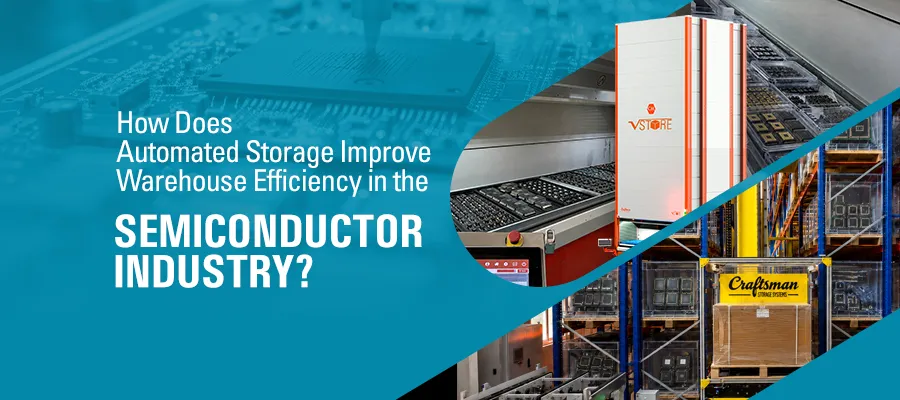
Craftsman ASRS stores highly sensitive items like silicon wafers, dies, microchips and other electronic components. VStore stores small semiconductor components such as diodes, microchips, and transistors, and Static Storage stores IC chips, resistors, capacitors, and connectors.
Want to Transform Your Warehouse Efficiency?
Discover our customised automation storage solutions that are engineered with speed, accuracy, and efficiency, resulting in long-term business growth.